
From Quito to Queens: A Classroom Story Told Through Student Voices
Eye on Immigration and Education > School Feature
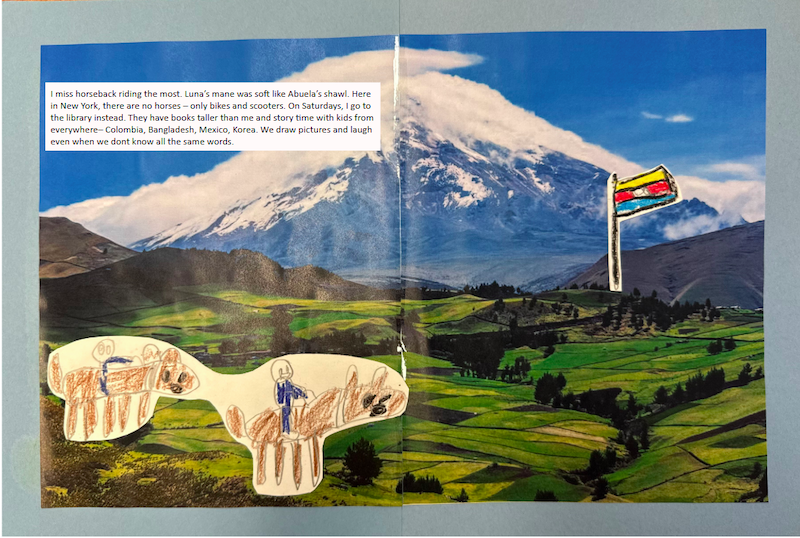
Paula enjoys writing and illustrating. In this image, we see how she used the collage technique to integrate the nature scenery of Ecuador with student illustrations.
When special education teacher Paula Diaz saw the ad for CUNY-IIE’s CTLE course “Teaching Immigration with PreK–5th Grade Children’s Literature,” she was immediately drawn to it. At PS280Q in Jackson Heights, Queens, Paula teaches a group of diverse students representing many countries, so she found the course, which highlights resources in CUNY-IIE’s Immigration LiteratureGuide: Stories for Visibility,Understanding and Transformation, to be a powerful learning space to further improve her practice.
As part of her work in the course, Paula wanted to build a book with her students. “I kept thinking about how much my students already carry with them,” she said. “Their stories, their families, their transitions. It’s already there. My job is to help bring it out.” From Quito to Queens follows Christopher’s experience moving from Ecuador to New York, comparing life in both places through everyday moments—family routines, church, school. Christopher contributed the illustrations, while Paula shaped the written narrative based on their conversations. “He would describe something, and I would just listen and write,” Paula explained. “Then he would draw it”.
One of the most meaningful parts of the project, Paula shared, was recognizing how differently students can shine when given space to do so. “Christopher is one of those students who may not always show his thinking in traditional academic ways,” she said. “But when he draws, everything is there—his understanding, his humor, his memory. Instead of seeing that as separate from learning, Paula built the project around it. “My students come from so many different places. They deserve to see that reflected in what we read and create.”
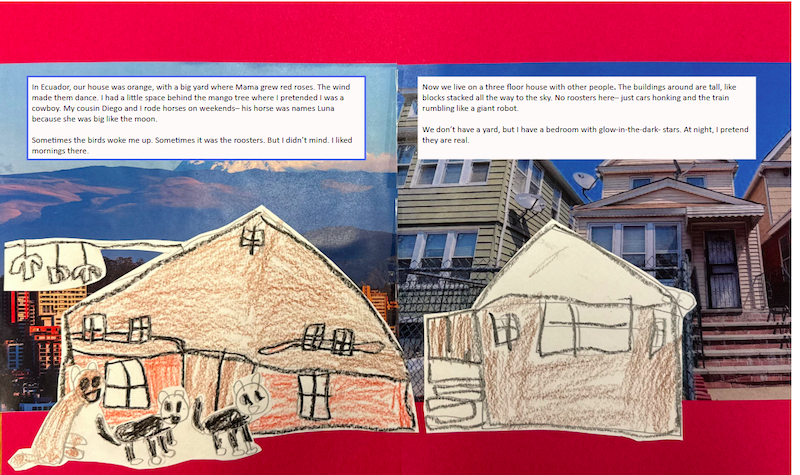
Throughout the book, Paula and Christopher describe the differences between Ecuador and NYC. The narrative is drawn from the testimonies of her students, who are also from Ecuador.
The CTLE course helped Paula make explicit connections to the literature. Supported by Prof. Cecilia Espinosa, Paula integrated key reading strategies that made the experience more accessible to her students. Through visualization and mapping journeys, students traced movement between places, while text-to-self and text-to-world connections helped them link the story to their own lives. Guided discussions around belonging opened space for reflection, and close reading of images encouraged students to “read” visuals as carefully as text. This process also deepened their visual literacy, as they explored elements like the landscapes of the Andean Highlands, textiles and markets, and the meaning of color symbolism embedded throughout the story.
Paula is now ready to begin working on her next book!
Article authored by Carmina Makar and Tamara Alsace | May 12, 2026